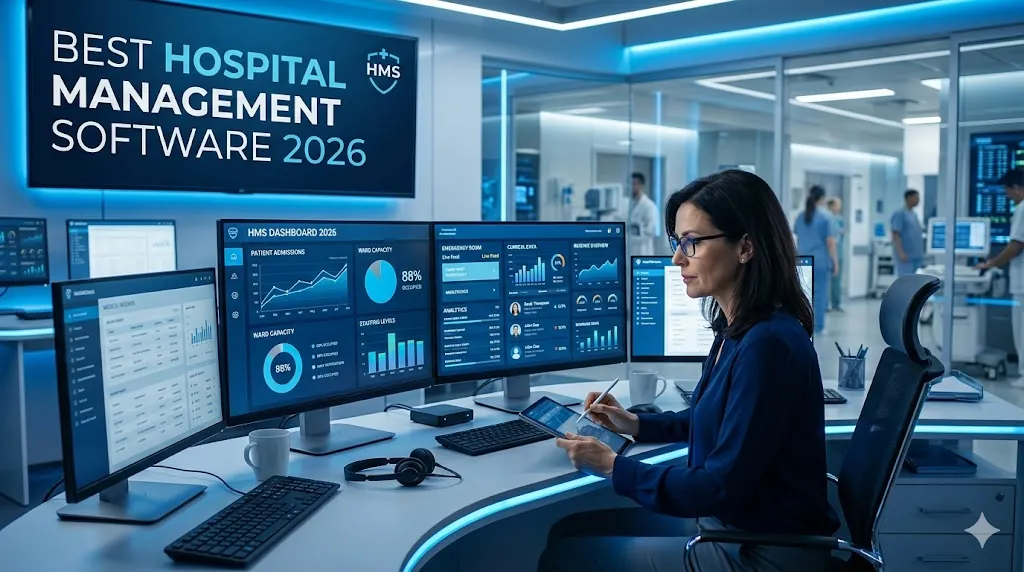
Choosing the best hospital management software (HMS) is critical for healthcare facilities looking to streamline operations, reduce costs, and improve patient care. From electronic health records (EHR) to billing automation and telemedicine integration, modern hospital management systems handle everything under one platform. This guide reviews the top 10 hospital management software solutions for 2026 with pricing, features, and real-world comparisons.
What Is Hospital Management Software?
Hospital Management Software (HMS) is an integrated information system designed to manage all aspects of a hospital’s operations – from patient registration and appointment scheduling to billing, inventory, pharmacy, laboratory, and HR management. A good HMS replaces paper-based processes, reduces medical errors, and helps hospitals comply with healthcare regulations like HIPAA.
Top 10 Best Hospital Management Software 2026
1. Oracle Health (Cerner) – Best Overall HMS
Oracle Health (formerly Cerner, acquired by Oracle in 2022 for $28.3 billion) is the most widely deployed hospital management system globally. Used by over 27,000 healthcare facilities worldwide, it offers a comprehensive suite covering EHR, revenue cycle management, population health, and clinical decision support.
Key features: AI-powered clinical decision support, integrated telemedicine, automated coding and billing, real-time analytics dashboard, interoperability with 500+ third-party systems. Their new cloud-native platform (Oracle Health Clinical) reduces IT infrastructure costs by up to 40%.
Pricing: Custom enterprise pricing, typically $500,000–$5M+ for large hospitals. Cloud subscription starts at $1,200/provider/month for smaller clinics.
Best for: Large hospitals and health systems with 200+ beds.
2. Epic Systems – Best for Large Health Networks
Epic Systems dominates the US hospital market with approximately 38% market share among large hospitals. Based in Verona, Wisconsin, Epic is known for its comprehensive, tightly integrated platform that covers every aspect of hospital operations. Over 305 million patients have a current Epic record.
Key features: MyChart patient portal (used by 190M+ patients), Epic Cosmos research database (250M+ patient records), AI-assisted documentation, predictive analytics for patient deterioration, seamless multi-facility data sharing via Care Everywhere network.
Pricing: Implementation costs $1M–$500M+ depending on hospital size. Annual maintenance typically 15-20% of implementation cost. Not available for hospitals under 25 beds.
Best for: Large health systems, academic medical centers, multi-hospital networks.
3. MEDITECH Expanse – Best for Community Hospitals
MEDITECH Expanse is purpose-built for community and rural hospitals that need enterprise-level functionality at a more accessible price point. Serving over 2,300 hospitals globally, MEDITECH has evolved from a legacy system to a modern web-based platform with impressive capabilities.
Key features: Web-based EHR accessible from any device, Google Health AI integration for clinical insights, automated surveillance for sepsis and patient deterioration, built-in patient engagement tools, Revenue Cycle Management with AI-powered denial prevention.
Pricing: Implementation starts at $200,000 for small hospitals. Cloud-hosted Expanse starts at $400/provider/month. Significantly more affordable than Epic or Oracle Health.
Best for: Community hospitals, critical access hospitals, 25-300 bed facilities.
4. Athenahealth – Best Cloud-Native Solution
Athenahealth offers a 100% cloud-based hospital management platform that requires zero on-premise hardware. Their network-enabled approach means every update, security patch, and regulatory change is automatically applied across all 160,000+ provider clients simultaneously.
Key features: Automated claim scrubbing with 97%+ first-pass acceptance rate, AI-powered patient no-show prediction, integrated fax/document management, mobile-first design, real-time benchmarking against network peers.
Pricing: Percentage-of-collections model (typically 4-8% of net collections) or flat rate starting at $350/provider/month. No large upfront implementation cost.
Best for: Small to mid-size hospitals and multi-specialty clinics wanting to avoid large capital expenditure.
5. Infor CloudSuite Healthcare – Best for Operations Management
Infor CloudSuite Healthcare focuses on the operational and financial side of hospital management – supply chain, HR, finance, and asset management. While it doesn’t include clinical EHR, it integrates seamlessly with clinical systems like Epic and Cerner.
Key features: AI-driven supply chain optimization (reduces waste by 15-25%), predictive staffing models, automated procurement, real-time financial analytics, equipment lifecycle management with IoT integration.
Pricing: Subscription-based starting at $50,000/year for small hospitals. Enterprise pricing available for large health systems.
Best for: Hospitals needing strong back-office and supply chain management alongside existing clinical systems.
6. eClinicalWorks – Best for Ambulatory Care
eClinicalWorks serves over 150,000 providers and 850,000+ medical professionals. Their V12 platform offers a unified experience across inpatient and outpatient settings with strong emphasis on interoperability and population health management.
Key features: PRISMA health information search engine, Eva AI virtual assistant, integrated telehealth with 50M+ virtual visits processed, chronic care management tools, automated quality reporting for MIPS/MACRA.
Pricing: Starts at $449/provider/month for full EHR + Practice Management. Implementation typically $5,000-$15,000 per provider.
Best for: Outpatient clinics, ambulatory surgery centers, and multi-specialty group practices.
7. Allscripts (Veradigm) – Best for Interoperability
Veradigm (formerly Allscripts) excels in health data interoperability, connecting over 100,000 providers, pharmacies, health plans, and life science companies. Their open platform approach makes it ideal for hospitals that need to share data across multiple systems.
Key features: Open API architecture, Veradigm Network connecting 300,000+ providers, advanced analytics and population health tools, e-prescribing with real-time drug interaction alerts, payer connectivity for prior authorization automation.
Pricing: Custom pricing based on facility size. Typically $300-$600/provider/month for cloud solutions.
Best for: Hospitals and health systems prioritizing data exchange and interoperability.
8. Insta HMS by Practo – Best for Asian Markets
Insta HMS by Practo is one of the leading hospital management systems in Asia, serving 5,000+ healthcare facilities across 50+ countries. It’s particularly popular in India, Southeast Asia, and the Middle East, offering multi-language and multi-currency support.
Key features: 50+ integrated modules (OPD, IPD, pharmacy, lab, radiology, blood bank), mobile app for doctors and patients, insurance TPA integration, multi-branch management, NABH/JCI compliance reporting.
Pricing: Starts at $200/month for small clinics. Hospital pricing from $800-$3,000/month based on bed count. Very competitive for emerging markets.
Best for: Hospitals in India, Southeast Asia, and Middle East markets.
9. NextGen Healthcare – Best for Specialty Practices
NextGen Healthcare specializes in serving specialty medical practices with workflows tailored to over 50 medical specialties. Their platform handles everything from scheduling to billing with specialty-specific templates that save clinicians significant documentation time.
Key features: 50+ specialty-specific content libraries, AI-powered ambient listening for clinical documentation, integrated patient engagement suite, NextGen Office (cloud-based for small practices), advanced analytics with 300+ pre-built reports.
Pricing: NextGen Office starts at $299/provider/month. NextGen Enterprise pricing is custom, typically $500-$900/provider/month.
Best for: Multi-specialty clinics and specialty-focused practices (orthopedics, cardiology, behavioral health).
10. OpenMRS – Best Free Open-Source HMS
OpenMRS is a free, open-source medical record system designed primarily for developing countries. Backed by organizations like the Regenstrief Institute and Partners In Health, it runs on minimal hardware and supports offline functionality – critical for areas with unreliable internet.
Key features: Completely free and customizable, 7,500+ implementations globally, modular architecture, offline-capable, REST API for integrations, active community with 4,000+ contributors, supports 50+ languages.
Pricing: Free (open source). Implementation support from certified partners costs $10,000-$50,000 depending on customization needs.
Best for: NGO-run hospitals, facilities in developing countries, and clinics with limited budgets.
Comparison Table: Hospital Management Software 2026
| Software | Deployment | Starting Price | Best For | Users |
|---|---|---|---|---|
| Oracle Health | Cloud/On-premise | $1,200/provider/mo | Large hospitals | 27,000+ facilities |
| Epic Systems | On-premise/Hosted | $1M+ implementation | Health networks | 305M+ patients |
| MEDITECH | Cloud/On-premise | $400/provider/mo | Community hospitals | 2,300+ hospitals |
| Athenahealth | Cloud-only | $350/provider/mo | Small-mid hospitals | 160,000+ providers |
| Infor CloudSuite | Cloud | $50,000/year | Operations mgmt | 5,000+ customers |
| eClinicalWorks | Cloud/On-premise | $449/provider/mo | Ambulatory care | 150,000+ providers |
| Veradigm | Cloud/On-premise | $300/provider/mo | Interoperability | 100,000+ providers |
| Insta HMS | Cloud | $200/month | Asian markets | 5,000+ facilities |
| NextGen | Cloud/On-premise | $299/provider/mo | Specialty practices | 100,000+ providers |
| OpenMRS | On-premise | Free | Developing countries | 7,500+ sites |
Key Features to Look for in Hospital Management Software
When evaluating HMS solutions, prioritize these essential features:
- Electronic Health Records (EHR) – Core patient data management with clinical documentation
- Revenue Cycle Management – Automated billing, coding, claims processing, and denial management
- Patient Portal – Self-service scheduling, bill pay, lab results, and messaging
- Telemedicine Integration – Built-in video consultations, especially critical post-2020
- Interoperability – HL7 FHIR compliance for data exchange between systems
- Analytics & Reporting – Real-time dashboards for clinical, financial, and operational KPIs
- Mobile Access – iOS/Android apps for physicians and staff
- Security & Compliance – HIPAA compliance, encryption, audit trails, role-based access
Hospital Management Software Implementation Tips
Successfully implementing an HMS requires careful planning:
- Assess your needs – Document current workflows, pain points, and must-have features before evaluating vendors
- Budget realistically – Include training, data migration, customization, and ongoing maintenance costs (typically 15-20% of initial investment annually)
- Plan for data migration – Migrating from legacy systems can take 6-18 months. Budget adequate time and resources
- Invest in training – Allocate at least 20% of your implementation budget for staff training. Poor adoption is the #1 reason HMS projects fail
- Go live in phases – Roll out modules gradually rather than all at once to minimize disruption
FAQ: Hospital Management Software
What is the most widely used hospital management software?
Epic Systems is the most widely used HMS in US hospitals, holding approximately 38% market share among large hospitals. Globally, Oracle Health (Cerner) leads with deployments in 27,000+ facilities across 30+ countries.
How much does hospital management software cost?
Costs vary widely: cloud-based solutions start at $200-$500/provider/month, while enterprise on-premise systems like Epic can cost $1M-$500M+ to implement. Small clinics can get started with OpenMRS (free) or Athenahealth (pay-per-collection model with no upfront cost).
Is there free hospital management software?
Yes, OpenMRS is a robust free, open-source option used by 7,500+ facilities globally. Other free/low-cost options include GNU Health and OpenEMR. However, free solutions require technical expertise for setup and maintenance.
How long does HMS implementation take?
Small clinics can be up and running in 2-4 months with cloud solutions. Mid-size hospitals typically take 6-12 months. Large health system implementations (like Epic) can take 2-5 years for full deployment across all facilities and modules.
Can hospital management software integrate with existing systems?
Most modern HMS solutions support HL7 FHIR standards and offer APIs for integration. Cloud-based solutions like Athenahealth and Oracle Health have extensive integration marketplaces. However, legacy system integration may require custom middleware development.
Final Verdict
The best hospital management software for 2026 depends on your facility’s size, budget, and specific needs. For large health systems, Epic Systems and Oracle Health offer the most comprehensive solutions. Community hospitals should consider MEDITECH Expanse for its balance of features and affordability. Small clinics benefit most from Athenahealth’s cloud-native, no-upfront-cost model. And for facilities in developing countries, OpenMRS provides enterprise-grade functionality at zero cost. Invest in thorough evaluation and proper implementation – your HMS will be the backbone of your hospital’s operations for years to come.